
More than seven years into my journey in sports development, after leaving my IT career and the United Nations, I realised I lacked the language to describe what I had become. People framed it as a “pivot,” a dramatic career change, but that never felt true. I was not abandoning anything; I was carrying everything I had learned and lived. My systems thinking from IT, my exposure to global institutions, my experience in grassroots football, and my fascination with how societies organise themselves — all these elements were evident in my work. Still, I had no term for the phenomenon.
Then, unexpectedly, a simple conversation finally gave me the name I had been searching for.
A lady I met during the Strathmore Alumni of the Year Service to Society awards reached out to talk about her daughter, a young creative working at the intersection of music, writing, and performance. She described her daughter not as someone with many skills, but as someone whose creativity flows through multiple channels. When she sits at the piano, something she wrote earlier might subtly guide her touch. When she constructs a performance piece, a tone or texture from her poetry finds new expression in movement or sound. These are not separate pursuits. They grow from the same root.
Her project, MOS — the Myth of Self-Becoming, makes this clear. It is a live, evolving practice that brings together sound, text, and visual elements to create a shared emotional space between performer and audience. It is embodied work — meaning created not in abstraction but in presence and interaction. She is now developing a new MOS piece that will premiere in Kenya in the summer of 2026, and, as her mother described it, everything she described felt familiar to me, though I had never named it.
She used one word: expandability.
The moment she said it, everything in my own journey suddenly made sense.
The Logic of Expandable Minds
Human beings have always been expandable. What we learn in one domain influences how we see another. Cognitive infrastructure, that is, pattern recognition, emotional intelligence, strategic anticipation, and systems awareness, does not remain neatly confined. It flows.
Football offers some of the clearest examples. Mohamed Salah speaks openly about his “addiction” to chess. Trent Alexander-Arnold studies chess to learn how to think three moves ahead. Pep Guardiola spent a year studying Garry Kasparov’s positional thinking. Enzo Maresca wrote an entire thesis on the shared strategic architecture between chess and football. Simen Agdestein became a chess grandmaster at eighteen while playing as a striker for Norway’s national team, and later coached Magnus Carlsen.

These are not random overlaps. They reveal how cognitive structures move across contexts. A footballer reading space, a chess player controlling the board, and a technologist debugging a system are using the same mental muscles: anticipation, pattern recognition, orientation, and decision-making under pressure.
Expandability is not multitasking. It is not “many skills.” It is the coherence of a mind expressing itself in multiple ways.
When I left the UN, I did not cease to be a systems thinker. When I immersed myself in football development, I did not abandon technology or governance logic. These elements naturally fused into my work on The Football Foundation for Africa, The Africa Football Business Show, the Summit, and, more recently, the Football as Infrastructure (FaI) model.
I was not switching careers. I was expanding.
Where Africa Pays the Price for Narrowness
Understanding expandability revealed how Africa unintentionally undermines itself. Our institutions celebrate early specialisation — narrow identifications with one discipline, one role, one lane. Yet the ecosystems we’re trying to build are far from mature. They require minds that can stretch across sectors, connect ideas, and build systems from scratch.
Instead, we train people for positions that don’t exist and careers that collapse the moment one pathway closes.
We lose young athletes, especially footballers, because we value their bodies and ignore their minds. When football stops, their options shrink. We lose creative thinkers because we tell them to “pick one thing,” cutting off the very flow that could make them innovators. We lose technologists who could revolutionise governance or agriculture because their training is overly rigidly structured. We lose administrators who could become institution builders because we box them too early.
Africa’s brain drain does not begin at the airport. It starts in the classroom, the academy, the federation, the university, and the home. It begins when we teach young people that having depth means narrowing their lives rather than enriching them.
Our development challenges, whether in football, governance, education, or business, require people with a broad range of cognitive abilities. People who can think like administrators and dream like artists. People who can navigate communities and analyse systems. People who can work across the emotional, the technical, and the political.
We cannot build the Africa we imagine using minds we insist on shrinking.
Expandability Is Part of Our Heritage
Long before the modern world divided knowledge into professions, African societies practised expandability instinctively. The village elder was a historian, mediator, storyteller, spiritual guide, conflict resolver, and community organiser. These were not separate roles. They were different expressions of wisdom. Our healers understood plants, psychology, and community diplomacy. Africa had ecosystems in which knowledge was layered, and contributions were multifaceted.
The idea that talent must be narrow is not African. It is an imported paradigm from industrial-era Europe, designed for factory production, rigid roles, and predictable output.
Our societies, however, are fluid, relational, and interconnected. Our problems require adaptable minds. Our opportunities require creators, not just workers. Expandability is not new to Africa. It is a memory awaiting revival.
Towards a Future Built by Expandable Thinkers
When I reflect on the work we are doing through The Football Foundation for Africa, the Africa Football Business Summit, and, more recently, the FaI model, I see clearly that what Africa needs is not just more funding nor only technical expertise. We need talent that can build ecosystems rather than function within them.
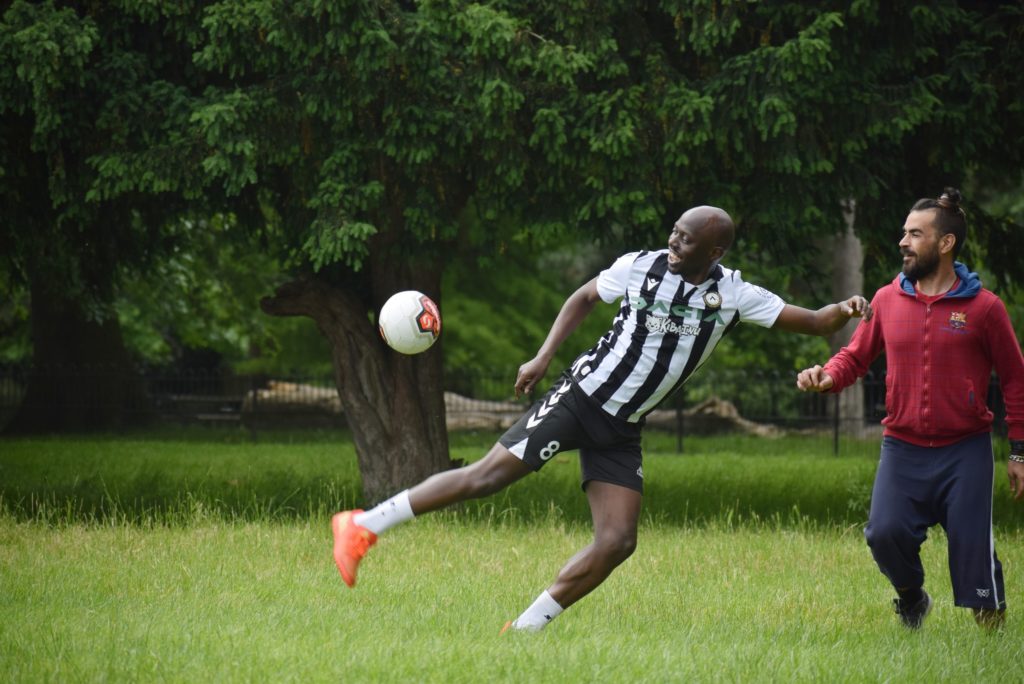
Imagine a football ecosystem where the player is encouraged to think, analyse, lead, and innovate, where the coach understands community development, where the administrator grasps technology and governance, and where investors appreciate not only financial return but the emotional and social architecture of sport, where young people are taught that their interests are not competing voices, but collaborating ones.
Imagine an Africa where expandability shapes our institutions — where people are hired for their cognitive capacity rather than the narrowness of their profile; where organisations create environments that allow people to grow far beyond their job descriptions; where leaders are not specialists trapped in silos but connectors capable of building bridges between fields.
Expandability and Specialisation
This does not mean that narrow specialists are unimportant. They are indispensable.
A high-performance ecosystem cannot function without people who possess deep, focused expertise, such as the physiotherapist who understands the body at the microscopic level, the data analyst who identifies patterns across thousands of variables, the legal expert who protects institutions from collapse, or the coach whose depth of technical knowledge shapes elite performance. But even specialists need environments that allow their expertise to matter. Expandable thinkers build those environments — the structures, systems, and relationships within which specialists can thrive. Africa does not need less specialisation; it needs ecosystems where depth and breadth reinforce one another, where specialists are empowered by visionaries who can connect the dots.
When I look at the MOS artist preparing to perform in Kenya in 2026, or the footballer using chess to refine his intelligence on the pitch, or my own journey from IT to global development to football governance, I do not see multi-career paths. I see single minds expressing themselves fully.
These are not exceptions; they are prototypes for the kind of talent Africa needs.
Expandability allows us to cultivate people who do not collapse when one door closes, who do not shrink to fit inherited structures, and who can build the institutions our continent still lacks.
If we want to build Africa’s football future — and, by extension, its social and economic future — we must invest in minds that can expand.
Because the future we need will not be crafted by narrow specialists alone.
It will be built by the expandable, working alongside the deeply specialised, each strengthening the other.
My thanks to Cordy Mwesiga for the conversation that sparked this piece, and to her daughter Nanjala Antonia Musundi, whose work embodies the very concept we’re exploring.
What examples of expandability have you witnessed? How might we better cultivate it in the sectors and communities we work in?