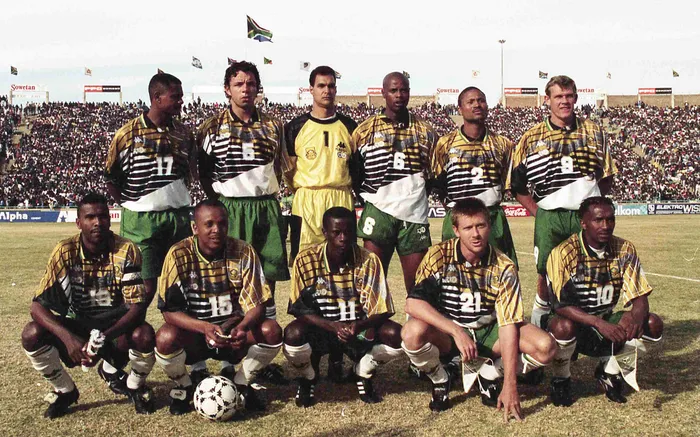
Watching the new Netflix six-part series, Class of ’96, did something I didn’t expect. It took me back to South Africa’s triumph at the 1996 Africa Cup of Nations, a tournament Kenya was meant to host, until a lack of preparedness cost us that honour. The brilliance of Doctor Khumalo, Mark Fish, Lucas Radebe and John Moshoeu. But also something closer to home: a ‘down-the-field’ — what we called the pitch at the bottom of the school slope — in Lavington Primary School in Nairobi, where football was already more than a game to me. It was identity.
Back then, I didn’t say I played football. I said I was a footballer, one of the best at the school. Confident on the pitch, expressive in moments, occasionally pulling off a trick or two. But off it, though a troublemaker, I was quieter, observant, reflective. Football was where I spoke most clearly.
One memory from around that time has stayed with me. We didn’t always have a ball. The school never provided one. Usually, someone would bring it from home, and when no one did, there was no game.
One day, my deskmate in Standard 6, Dann Mwangi (yes, the NTV Business News Anchor and Spoken Word artist; he was also a good goalkeeper), told me his mother wanted to buy him a ball but didn’t have enough money. It felt like a solvable problem. So, I did what came naturally to me even then—I mobilised the class. Looking back, it is interesting; it was a boys-only affair.
We contributed what we could. Coins, small notes. Enough to raise about half the amount. We gave it to Dann, and he completed the rest. Soon after, we had a ball, red and white, if I remember well.
But more than that, we had a system.
We agreed that everyone who contributed would take turns taking the ball home. It wasn’t just about playing; it was some shared ownership, with Dann holding a majority stake. Access. Fairness. For a few days, everything worked perfectly. We looked forward to the mad rush to “down-the-field” during the breaks and after school.
Then one day, Dann came back with a different message. His mother had raised money to refund everyone so he could keep the ball.
I remember feeling disappointed. Not just because of the ball, but because something we had built together had shifted. And if I’m honest, I didn’t handle it perfectly. My naughty side showed.
With this news, I mobilised the class again, but this time with a different energy. I reorganised the contributions, expanded participation, and, in the process, made sure that what came back to us—myself included—was more than we had initially given. Even those who hadn’t contributed found themselves part of the new arrangement—a mix of fairness, frustration, and a bit of craftiness.
Looking back, I see both sides of it: the instinct to protect the collective, and the immaturity in how I expressed it. But even in that imperfection, there was something taking shape.
At the time, I didn’t have the language for it. It was just instinct. But instinct, I’ve learned, is just understanding that hasn’t found its name yet.
Today, I see it clearly.
That was an initial encounter with what I now call Football as Infrastructure.
Not as theory. Not as policy. But as lived experience.
Football needed a ball. The ball needed structure. And the structure needed people—organised, aligned, and committed to something beyond themselves.
The same dynamics I navigate today—governance, ownership, alignment, breakdowns in trust, and the constant tension between individual interests and the collective good—were already present in that small moment.
The scale has changed. The principles haven’t.
Watching Class of ’96 reminded me of the magic of that era—the flair, the pride, the identity it gave a generation of African children. We didn’t just watch players like Mark Fish, Khumalo or “Shoes.” We became them, in our own small ways. In estate tournaments and school kickabouts, those names were currency.
But it also reminded me of something even more important.
Long before the summits, the frameworks, and the partnerships, there was a boy who wanted the game to happen and was willing to organise people to make it possible.
Imperfectly. Creatively. Instinctively.
Thirty years on, the infrastructure question hasn’t gone away – Kenya finds itself in a familiar position. More on that later this week.